With such a great experience at WeeRibben National Park, we were excited about our next destination, Hoge Veleuwe National Park, unique in that it is actually privately owned, protecting forests, heaths, providing great camping and cycling, and maintaining an incredible museum. We knew our high expectations would be met when the first thing that greeted us at the park's entrance was, instead of a car parking lot, a massive bike parking area with some of the 1800 white bikes that are distributed throughout the park, free for visitor use.

Thanks to the availability of child bikes Tom got a chance to bike on his own and after a few hesitant tries was enthralled to be independently cycling.

The cycle paths went through forest and grasslands,

that on a solo sunrise ride made me feel as if I was in African savannah. Half expecting a pride of lions or wildebeests meant that I nearly jumped out of my skin when a herd of the native species of ram called the mouflon stampeded across my path in a rush to get away - for some reason they made me think of a pack of velociraptors a la Jurassic Park (yes I was scared of a herd of sheep). Clearly my brain was malfunctioning as during the same ride I came across a sign in front of the path indicating construction ahead. One of the words on the sign was something like pannekoeken, so naturally I assumed it was saying they were building a pancake restaurant. But in fact it was warning of potholes which I promptly smashed into, almost falling off my white park bike because I forgot how to use the old fashioned backward pedal brakes.
Smack in the middle of the park is the world class Kröller-Müller museum, containing works of art from Monet, Picasso and Mondriaan to name a few, plus the second largest collection of paintings and drawings by Van Gogh, curated with pieces from other artists from whom he drew inspiration or gave inspiration to. The national park is well off the tourist track, which means it is possible to contemplate famous paintings like Van Gogh's Cafe Terrace at Night,
and Sunflowers without any crowds (okay it's cheesy to take photos in an art gallery but other people did so I felt obliged).

My favourite part of the museum was the incredible outdoor sculpture garden, with gorgeous flowers and lush trees, so big we didn't have time to see all of it despite wandering around for almost an hour.
We were allowed to walk on and explore Jean Dubuffet's "Jardin d'email'

but touching the others was strictly verboten, though when I reminded Tom to keep his hands off this one he said it was already dented so it shouldn't matter.

During our final week in Holland we passed through many towns and cities, not able to do them justice but getting a taste for places we'd love to visit again. The first of these was Zwolle, where we stopped for a respite from the rain in a modern and beautifully designed museum/theatre/cafe with a great vibe and some awesome diy hot cocoa - a glass of warm milk with a block of chocolate on the side. Tom couldn't wait to dive in.

Zwolle has waterways right in the centre of town, including the concert hall, where two beautiful wooden gondolas awaited performers who wished to leave the building by boat.

Then Apeldoorn, where we had just enough time for a pit stop at the library, an airy and light building, with an astroturf menagerie in the outdoor courtyard.

The city of Arnhem had a highly recommended WWII museum that told the stories of the British paratroopers and other soldiers whose lives were lost in a misguided and ultimately doomed battle, whose strategic errors and outcome were reminiscent of that of Gallipoli. To allow the others to tour and read the stories in peace, I walked the gardens outside the museum building with Tom

and then went to a cafe where we happily wiled away an hour over cappuccino and hot chocolate.

After Arnhem we breezed into,

then out of Nijmegen,

in a hurry to get to our apartment a few km out of town. But when our bicycle path went right by the Canadian War Memorial in Grosbeeke, we took some time to stop and visit the graves and read the inscriptions,

feeling touched by the immense gratitude expressed there by the Dutch to Canadians.

People haven't forgotten the role the Canadians played in the Netherlands at the end of WWII, and we met one elderly man on our way (he was cycling and camping of course - the outdoor adventures of the Netherlands' populace seem to only increase with age) who said he remembers the first Canadians he met, when they came to his town during the war (and his sister married one of those Canadian soldiers).
We finally made it to Maastricht, but it wasn't an easy journey. We had pushed ourselves to do some extra km that day (so we could have the next day off) and ominous weather was approaching as we neared the site where we intended to spend the night.

When we arrived at the spot where our campground was supposed to be it wasn't there. Of course the area contains the country's steepest hills so we were fairly exhausted cycling up and down them at the end of the day in a desperate bid to find a campground. We finally found one, quickly set up the tent and jumped in the pool for a swim to cool down after our exertions, then headed to the reception to pay. We realized we had forgotten to go to the bank so had just enough money to pay for our site and get some fries at the awning covered snackbar when the thunder and lightning arrived. Fortunately it was open late to accommodate the drunken sports fans at the campground, so we sat there shivering until almost midnight when the lightning had passed and we could pass out in the tent.
Maastricht rewarded our efforts with sunshine the next afternoon for our stroll around town to admire the cathedral,
the ancient city walls,

and more great urban cycling scenery

to which we were now accustomed.
If we didn't have so much to look forward too, I could happily stop our journey here and stay in this cycling nirvana. Charming towns, amazingly planned cities, great campsites and cabins, and of course no problem communicating with the friendly and welcoming Dutch people who all seem to be perfectly fluent in English (though we did come across one interesting translation).

Some other cyclists we met here, Dutch and expat, said they found the Netherlands too much of the same thing and were happy to venture further afield for their cycling vacations. But for us it was perfection. We never tired of the waterside rides,

the paths on bridges and under highways, always safe for cyclists,

or the unexpected encounters with animals,

like the heron hanging out in a doorstep in Amsterdam,

the camels in one farmer's field,

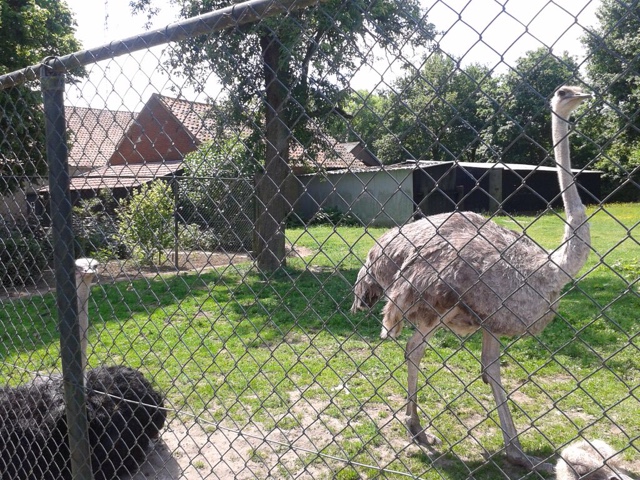
or the ostriches which twice we saw in people's front yards.
We also loved the many tiny water crossings made by ferry

that were either free or negligible cost. On one crossing it was pouring rain, and the captain of this ferry

took pity on us and invited us into his cabin for hot nettle tea and conversation. We hung out and chatted while the boat went back and forth across the channel - a route Hans told us had been running for at least five centuries.

And to top it all off everything in the Netherlands is designed to improve the environment for cyclists, from the roads where cars are allowed but told they are only guests,

to the pathside recycling bins where cyclists can jettison their water bottles without slowing down.

The saying is that God made the world, but the Dutch made the Netherlands, and I'd have to say they did a pretty good job. Little towns and big cities alike were beautiful and had their own particular flavour. Interesting architecture, picturesque houses with canals instead of front lawns, and stunning houseboats along the water lapping the shores.

There was also a sense of playfulness and purpose everywhere. Yes the buildings and town squares were wonderfully designed, but the aesthetics weren't limited to such obvious sites. Artistry was incorporated into everyday objects - scaffolding was vibrantly coloured - like the hot pink we saw in Amsterdam,

and royal blue in Maastricht.

Street signs in Amsterdam had whimsical decorations,

the guardrail to the highway in Gouda became a rollercoaster loop,


All these touches couldn't have cost much more than the standard drab counterparts in other urban centres, and they functioned just as effectively - how great would it be if we all adopted such creativity and beauty in the design of our built environments!
Of course no account of the Netherlands would be complete without a picture of people in a giant Dutch clog.

As we crossed the border into Germany our bike lane suddenly disappeared, and we worried that the good cycling times had officially come to an end. But three metres later a separated, wide and nicely paved bike path began, so we're hoping for the best in this country too!


