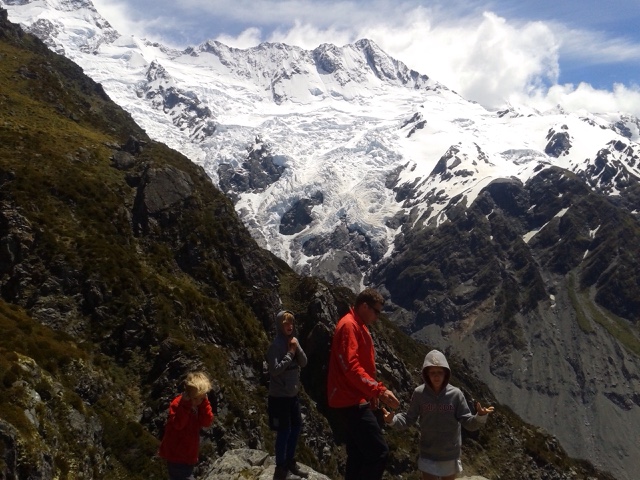
As I start what must be around the 35th blog I find I am running out of novel sentences to describe our travels. This leads me to wonder if my many subscribers (at least two including my mom and dad) are similarly tiring of reading the same turns of phrase after ten months, though hopefully still enjoy the pictures of places like turquoise Lake Tekapo, our first stop after Mount Cook.

I chatted about this literary conundrum with freelance writer Ricky French (the story of meeting him will come in a future missive) who advised me to try to mix it up with themes or varying perspectives, so I'm going to see if I can make this entry a little different and am basing it around a novel our family loved.
We've been through many books on this trip, but not many have entertained all five of us equally. The notable exception was Stephen Callahan's book "Adrift", a non-fictional account of the author's 76 day 3000 mile odyssey from the Canary Islands to the Caribbean in a six foot life raft. Adrift was the accompanying read for our time in New Zealand and the kids clamored each evening to hear the latest danger facing our hero (I hope I'm not infringing on copyright by paraphrasing the novel - please go buy it if so, I highly recommend it).
Stephen's journey started in a 21 foot sloop, setting off solo like Tom was below, albeit in the Atlantic ocean rather than Lake Tekapo.

It was meant to be a challenging crossing of the Atlantic, without a foot on dry land for weeks,

but quickly turned catastrophic, when his boat was sunk during a storm after colliding with an unknown object, possibly a whale much bigger than us human swimmers.

Narrowly escaping drowning in the blast of water that surged into his boat, he managed to cut free his raft before being forced to abandon ship. During his scramble to escape he salvaged a few key items, including Sea Survival by the Robertson family who had lived months at sea after a similar accident. Their children must have smiled mightily when they finally hit land.

Callahan kept his raft secured to the damaged boat as long as he could, hoping that when the storm subsided he could return to it and salvage the food and water rations on board. We had only to pack food for four days to survive our hike on the privately owned Banks Peninsula in the Akaroa region near Christchurch,

and our water, as well as local beer and wine if we desired, was supplied at each of the well equipped huts we stayed at along the way.

Callahan's raft was torn loose in the gale force winds and the wreckage of his ship sank before he could retrieve all that he needed, so he was forced to literally batten down the hatches while gigantic waves tossed him around. Huddled in the raft, the cover fastened tight, there was no view of the night sky. We stargazed through the clear ceiling of the ingenious hut we slept in during our first night, and while we were able to enjoy a peaceful sunrise,

our hero had to endure days of storms before he was able to poke his head out and view his surroundings.
He took stock of his raft supplies, far more limited than ours,

and found a few tins of water, emergency flares, three solar stills to distill fresh water from sea, a spear gun (Tom always tried to transform his sticks into weapons)

and a tiny bit of food including beef jerky.

With prevailing winds and currents carrying him further and further from Spain but such a vast distance to land on the other side, he felt his best chance was to make it to the nearest shipping lanes, hopefully busier than this one,

so that a passing freighter might spot him.
With no cascading waterfalls to sustain him,

his biggest challenge was obtaining fresh water. Waves continually swamped over the side of his boat, contaminating the meagre supplies of water he obtained from the poorly functioning solar stills. As for plant life,

there was only the occasional clump of seaweed to be seen, and too little of it at that.
Home was a distant memory, as were human companions.

While we were riveted by his physical struggle for survival, we were even more captivated by Callahan's mental battles and philosophical musings, especially about a group of dorado that became his travelling companions. Though they kept him awake and bruised his body as they rammed him constantly through the raft's thin fabric, they were also a source of nourishment when he was lucky enough to catch one with his spear gun. When he did capture them, he rejoiced at the sustenance their flesh provided, but mourned their passing and felt deep distress over taking their lives. We experienced some of that dissonance as we were eating lamb sausage that we'd purchased from our hosts. We loved to see the sheep grazing in the green pastures of the farmers whose land we trekked through,

and whose guest houses
and gardens we enjoyed,

and the kids thrilled at the opportunity to bottle feed the lambs.

Kyra abstained from the sausage (she remains staunchly vegetarian since her conversion in April), and the rest of us were aware of the cruel irony of eating lambs just like those we had seen in the fields, but a lifetime of eating meat lends itself to rationalization of the practice and as we wanted to support the farmers we were okay with the conflict, or so we thought.
One afternoon we heard the lambs and sheep start bleating, and when the sound continued unabated we asked the owners what was causing the commotion. They showed us the fenced in area in which all the lambs had just been corralled, separate from the pen the ewes had been temporarily placed in. The woeful bleating was the lambs and ewes calling to each other in distress, and it lasted for the entire night. Kyra went to bed crying and the rest of us lost our enthusiasm for our meal to say the least. In the morning the lambs were loaded into trucks and taken off for a final fattening at another field before their slaughter. While Callahan's emotional dilemma was easily resolved - it was eat the dorados or die - the sheep farming (and our consumption of lamb) posed more complex moral questions. These landowners were passionate about the environment and were preserving the land - both forest

and field

while maintaining the agricultural heritage of their forefathers. The farmers were also conserving endangered species such as the little blue penguins, 
who were able to safely raise their young in the nesting boxes the farmers built and protected.

Besides educating us and other hikers during the evening penguin safaris they led, they also took significant measures to exclude non-native predators from their land, like building a massive fence as one landowner did at her own expense to protect the cliff nests of the highly threatened shearwater,

and they lobbied the government for greater environmental protection of the lands around them.
Most of the time their sheep and lambs lived contentedly, browsing freely over large amounts of land,

but at the end of the day was that tragic separation of mother and child, involving death of the latter and genuine pain and suffering of both. Not easy to reconcile the ethics of the two realities.
Besides the emotional dichotomy of his diet, Callahan reflected on how each day brought both blessings and threats, often at the same time. Rainy days meant replenished supplies of fresh water, but also soaked his sleeping bag, chilled him to the bone, and worsened his boils and sores caused by constant chafing on the raft. Sun in the sky brightened his spirits and surroundings, brought welcome warmth, light and visibility to the horizon,

and dried out and healed his sores. But with no handy caves to shelter in,

he was at the mercy of the sun's rays, which soon led to dehydration, burned his skin and blinded him with the brilliance of the light reflecting on the blue water.

He fought mental battles with the isolation

and fear, not unjustified. While we saw seals frolicking in the sea

or crawling up onto the rocks to rest,

Callahan contended with their chief predator - sharks - who charged periodically. He was able to fend them off with his paddles but each encounter would leave him with damage to his raft, and he lived in constant dread of the next attack.
As we finished our walk on the Banks Peninsula, and headed to the Kaikoura Coast Track, also on private land, Callahan tried desperately to survive the final weeks of the ocean crossing. He had hoped for rescue once he reached the shipping lanes, still as quiet as a country road,

but the few freighters that did pass never stopped and it became apparent that he was going to have to make it all the way across the Atlantic if he was to survive. Once a freighter did approach him, coming so close that, were someone on deck, he could have seen their face. He used his precious supply of flares to alert the ship's watchmen, but they were either asleep at the wheel or busy with other duties and missed him, so he remained trapped in his raft.
We read his story of the battles with the ocean by night but by day saw only the beauty of the sea. Endless miles of beach stretched before and behind us,

and towering cliffs seemed to symbolize the security of dry land we were on.

We walked alongside pods of the very rare Hector's dolphins surfacing beside us, too small and elusive to capture on film,

then ascended up into the hills

through the greenery,
and onto the plateau,

where we spent the night at a quiet hut with the farmers as our neighbours.

We trekked back the next day returning to a beach house via grassy meadows
with yellow wildflowers brightening the path.

The sun of the previous day was obscured by heavy cloud cover,

and we found refuge from the wind and a billy can for making hot chocolate at the lunchtime hut at the top.

Our thoughts returned to Callahan, for whom changes in weather could mean life or death. We had become much more aware of the weather ourselves when cycling in Europe, since an approaching storm would mean more hazardous cycling and a wet night in our tents.

With the warmth and shelter of our Kaikoura beach hut at the end of the day we were free to observe the weather rather than worrying about it, and as it cleared we watched the sunset then returned to our cozy beds.


After saying our good-byes we went for a walk along the coast, where seals awaited, basking in the sun on rocks,

and seeking shade under trees that abutted the shore. The last thing we had expected to see was seals in the forest,

but they came right up to mere inches of the boardwalk,


Being social animals like us, they congregated in colonies, a community only dreamed about by Callahan as he faced his 75th day alone at sea.

Finally, on day 76, he drew close to the island Marie Galante, south east of Guadeloupe. His chances at surviving the journey to the shore were lower than they had been for the entire trip. It was more likely that his raft would be smashed into the rocky cliffs, or even be swept past the island entirely and be back into the open ocean. His trusty companions the dorados were what saved his life, just as they had during the long voyage.
The dorados had attracted seagulls to the raft, which in turn had attracted local fisherman, who spotted the birds from miles away and motored over to investigate. When they found Callahan, they offered to take him immediately back to shore, but instead of leaping at the chance, he told them to take their time while he lay back in the raft, enjoyed the sunshine, and relished drinking all his precious reserve of fresh water.
We tried to see parallels between his return to civilization and our transition from hiking in nature to strolling the damaged streets of the post earthquake Christchurch, not yet recovered from the massive tremors of 2011.
He was overjoyed at the abundance of food given to him by the villagers, while we feasted on delicacies from vendors at the street food festival in the city square.

But for the floating seaweed, he hadn't seen plant life for over two months. The tussocks we saw on the Godhead trails, just outside the city,

and the verdant growth alongside the Avon River in the centre,

contrasted with the concrete of abandoned buildings and the bizarre sight of grafitti on the top of condemned high rises.

After seeing only various shades of blue and grey for months on end, the colours of the tropics and the village around Callahan stunned him with their vibrancy. We found the tragic post-earthquake ruin and grey remains transformed into colourful montages by the pop-up art that has sprung up around the city. Enlivening the streets were brilliant murals, some poignant like this one depicting penguins melting into oblivion as climate change irreversibly warmed their polar habitat.

Providing opportunities for public engagement were chess boards, both large and small,

and bright green outdoor furniture fit for giants.

Best of all was the parking lot turned into a playground of sorts with a picnic table covered in solar cells for recharging mobile phones, a stone forest for games of tag and hike and seek,

and a dance-o-mat, which by inserting a few coins, and plugging your ipod into the connector emerging from the washing drum,

transformed the abandoned square into a dance floor with music resounding from the speakers and lights reflecting off the disco ball hanging above. The four of us danced with some other children by day to the Pitch Perfect soundtrack (Paul applauded from the sidelines), then returned our final evening, December 20th, to dance with a few more total strangers - a group of high school friends who were playing Taylor Swift and Mariah Carey's All I Want for Christmas. When they left we plugged in our player and sang along to our repertoire of six Christmas carols, swaying to Silent Night as the sky darkened completely.

The damaged city had a forlorn aspect about it, the streets deserted even at nine o'clock on a Saturday night, but the promise for a bright future was evident in the street art and the redevelopment found around the city. Christchurch's Art Gallery reopened the day before we left, and I think Stephen Callahan, despite the adversity he battled, would echo the hopeful message on its side.